~1.jpg)
Completed
Sustainable Carnaúba (Carnaúba Sustentável)
Encourages sustainable carnaúba management, strengthening value chains, promoting responsible environmental practices and benefiting local communities.


Location
Location
Community
The “Sustainable Carnauba Program” targeted around 40 families working at the base of the carnauba value chain, namely extractive workers and small rural producers responsible for selling powder to wax refining industries.
Carnauba enabled many rural workers to have a profitable activity during the dry season in the Caatinga, especially between August and December, the harvest period for the leaves. For the rural population, this was very significant, since family farming in Brazil’s semiarid region was largely dependent on the rainfall regime, which normally lasted for the first four (04) months of each year.
However, carnauba extraction was a traditional activity that, historically, had undergone few updates and innovations in its production system. Its main challenges therefore stemmed from inadequate management techniques, the lack of technologies to optimize productivity, and disregard for labor legislation.
The functioning model of the carnauba value chain was thus compromised by informality, poor health and safety conditions, lack of access to information, low profitability, dependence on intermediaries, and significant productivity losses of carnauba powder, reaching up to 50%.
In this context, the project’s activities converged on addressing these bottlenecks and building a model community—viable and formalized in carnauba extraction, with health, workplace safety, and productive efficiency—in order to encourage other producers to pursue the same transformations carried out by this initiative.
~1.jpg)
Species
Carnaúba (Copernicia cerifera)
Carnaúba is a palm tree native to the Brazilian Northeast, and its use dates back centuries. Essential for ecosystem balance, it helps conserve soil, protects rivers from erosion and siltation, its trunk can provide shelter, and its fruits serve as food for native wildlife.
The carnaúba supply chain is a unique example of sustainable extraction in the world, as the economic activity is essential for the survival of the exploited plant species. Untended carnaúba groves are decimated by the invasive species unha-do-diabo.
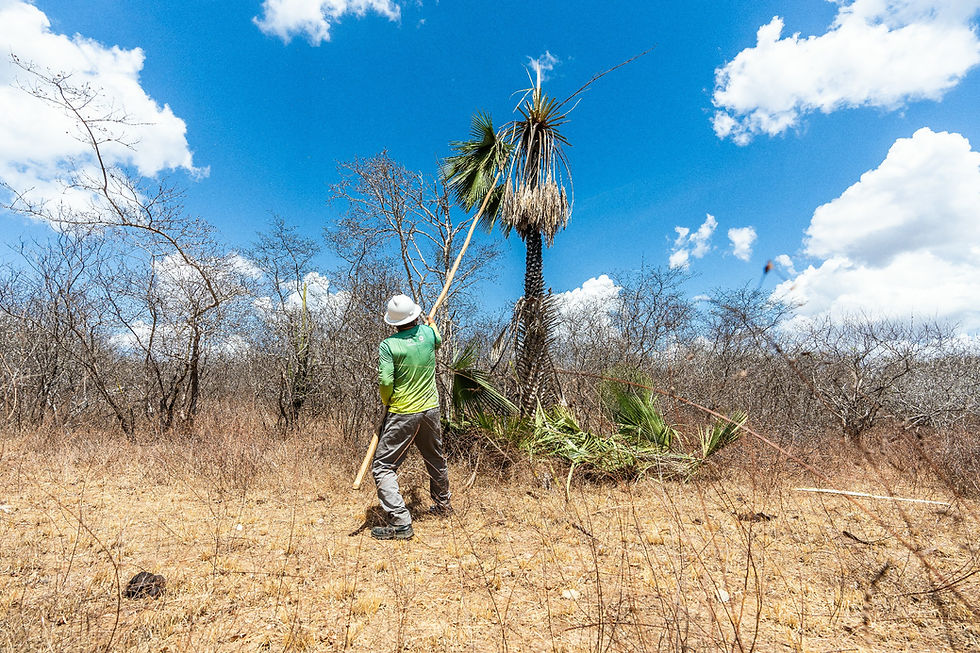
The entire supply chain involves a process that engages around 100,000 people in Ceará, starting with leaf harvesting performed by the “vareiro” using a 10-meter pole. The leaves are dried at drying yards, and after 10 days of drying, the powder is collected for the preparation of vegetable wax. Brazil is the sole exporter of carnaúba wax, which is used in the production of cosmetics, medicine capsules, varnishes, soaps, lubricants, and more.

Activities
Contribute to the professionalization and modernization of the carnauba value chain
This activity involved the formalization of a collective work and production agreement with the selected community. The process was guided and supervised by specialists, including an accountant and a lawyer, and aimed to establish the rights and duties of each actor in the process. Additionally, a good practices leveling workshop for the carnauba value chain was offered to fill the gap in access to information among rural communities, and it aimed to disseminate knowledge and motivate carnauba-producing communities to advance toward the modernization and qualification of the value chain.
Improve productivity, health, and occupational safety conditions of carnauba workers, and disseminate traceability techniques
Training was provided on the use of recommended personal protective equipment (PPE) for the activity, along with the implementation of a solar dryer that met the community’s production needs. An adapted threshing machine was used for the extraction of carnauba powder, monitored and evaluated by a project technical consultant. This equipment increased the yield and quality of the powder while reducing worker effort, as the leaves no longer needed to be turned and crushed to dry completely and release the powder.
Monitor community development and publish results at the end of the project to disseminate the work model
This monitoring process provided the necessary conditions for the development of project activities, ensuring that, over time, each activity delivered the prerequisites of competencies (knowledge, skills, and attitudes) required for subsequent activities.
Impact
38
carnauba-harvesting families trained in good management practices and the use of PPE
1
collective production agreement formalized
1
adapted solar dryer implemented and used
12
monitoring visits conducted
90 kg
of carnauba eye powder produced
10,000
dried stalks allocated for handicrafts


Grupo Boticário
One of the world’s largest beauty groups, Grupo Boticário is a Brazilian company present in 50 countries. It owns the brands O Boticário, Eudora, Quem Disse, Berenice?; BeautyBox, Vult, O.u.i, Dr. JONES, Truss and the marketplace Beleza na Web, and also operates with licensed products such as Australian Gold and its B2B division. This interaction between different brands, active ingredients, platforms, a network of franchisees, representatives, distributors, retailers, sellers and suppliers forms Grupo Boticário’s beauty ecosystem, which also offers digital business management solutions for Brazilian retail through its brands Mooz, Casa Magalhães and GAVB. It has more than 15,000 direct employees and over 4,000 points of sale in 1,780 Brazilian cities.

Associação Caatinga
Founded in Ceará in 1998, with the support of the Samuel Johnson Fund for the Conservation of the Caatinga, it has the mission of promoting the conservation of the lands, forests and waters of this biome, ensuring the permanence of all its life forms. It has worked for 25 years in the conservation and valorization of the only exclusively Brazilian forest, threatened and concentrating the greatest biodiversity among semi-arid regions on the planet.

VBIO.eco
A bioeconomy platform that enables projects to add value to Brazilian biodiversity. It has a multidisciplinary team with more than 12 years of experience in project management and corporate communication. Its work has enabled the implementation of 23 biodiversity valorization projects and created a network of over 500 organizations and companies active in socio-environmental causes.